Football in Berlin: where to play, watch and how to get involved?
(disclaimer: not written by Gen AI; all photos by Davyd Trunyov)
Imagine a place with the most important information about football in Berlin: where to play, where to watch live and with fans, how to get actively involved, and a sprinkle of useful trips, information and things to try.
This is the place.
I am glad to present this collaborative article with a lot of links to primary/secondary sources. I’d like to thank my co-authors, Nik Newcamp and Davyd Trunyov. You should check out Nik’s blog, The Backroom Staff, or join Davyd’s tip-based guided tour. I’d also like to thank Juan Almeyda for significant improvements in several sections of the article.
In the likely event of missing or wrong information, send me a message.
Chapters overview
How to get involved by playing, coaching or volunteering in Berlin?
A brief overview
Football in Germany is organized through various criteria, ensuring a structured and inclusive environment for all participants. Here’s a breakdown:
- Type of Game:
- 11 vs 11: The traditional format, played on a full-sized pitch
- 7 vs 7: A smaller-sided game often used for youth and recreational matches.
- Futsal: A variant of indoor football played on a smaller, hard court with a smaller, less bouncy ball.
- Type of Competitiveness:
- Regular Teams: These are more structured and competitive, usually with a dedicated coach and scheduled training sessions.
- Freizeit (Recreational): These teams are more relaxed, often self-organized by friends, and typically without formal coaching.
- Age Categories:
- Adults: Includes the main leagues and competitive adult teams.
- Kids: Youth leagues and development programs for children.
- Older People: Leagues and teams specifically for older adults, promoting fitness and social interaction.
- Levels of Competition: from the top-tier Bundesliga to the lower-tier Kreisliga C, there are multiple levels of competition catering to different skill levels and ambitions.
This structure ensures that everyone, regardless of age or skill level, can find a suitable place to enjoy football, whether playing, coaching, or volunteering.
Where can you play football in Berlin?
You have several options. You can book your pitch or go to one of the public ones, but the easiest way will be to join different recreational leagues and pick-up games.
You can find many free games in the Matchbase Berlin Whatsapp group, which is the legacy group of the app with the same name. Another option is to check Meetup, for example, Berlin Wednesday/Friday (Poststadion in Moabit near HbF), Terrible Football (Saturdays at 16.00, Poststadion) or Amateur Football directly after at 18.00.
You can also check out the app Jugad, where you can find players and football sessions.
You can also try the Facebook group Football-Soccer-Fußball-Fútbol-Futebol-Calcio in Berlin! with over 4000 members to organise and join teams, public pick-up games, find a club to join or look for new players for your team.
For more organised teams, Startup League is a good option.
If you are a student or work for a university, you can join student teams at Uni Fußballliga or assemble a team and join TU Fußballliga.
You can also play at Humboldt University, FU Berlin or Charité. But, if you’d like a more serious game, consider joining a competitive club…
How do you find your local football team in Berlin?
The first step is to go to Fußball.de and search for your postcode in the search box. It cannot get more local than that. Most clubs will have multiple teams competing in different divisions. Depending on the size of the club, this might include a 2nd or even 3rd team, Freizeit, Indoor or Futsal and/or a host of youth teams.
Teams often also have teams by age, for example, ü32 which means older (über) than 32 years old, where players train once a week and are suitable for players with jobs and families. There are also ü40, ü50, and even ü60!
Joining a team can be as simple as stopping by at a training session (many clubs post their training schedules on their website) or contacting the club to join or tryout. It’s also common to see clubs posting open spots on their website or social media.
If you are looking for English-speaking club in Berlin, redditor robertlongo recommended British Lions FC - you can find them easily on Fußball.de.
For example, if you are interested in joining Hertha Berlin you will find the following 34 teams (with the information on the league level):
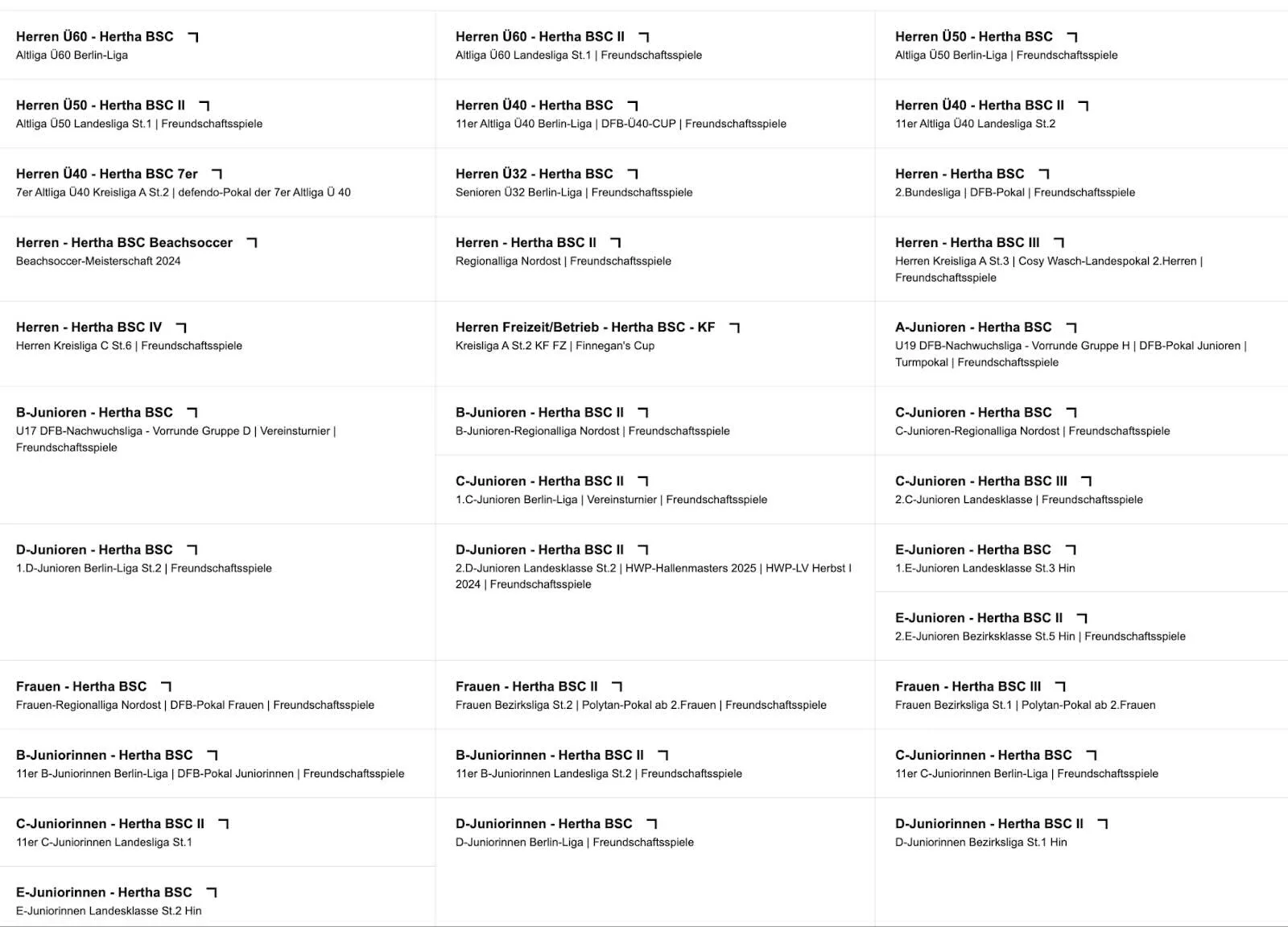
The number of teams generally depends on the size of the club. There are a ton of offers!
How to coach football in Berlin? How to become a referee?
To get a football coaching license, you will need a solid German. The organisation responsible in Berlin is Berliner Fußball Verband.
You can also become a referee. A detailed description of how to become a referee is available here in German: there are a few different courses available, and your age doesn’t play a role. Needless to say, you will also need German (or Arabic in one particular course). You can sign up for a beginner course to become a referee at Berliner Schiedsrichter.
Referees are paid (link to example rates per game from 2020) and also get access to free tickets for any Bundesliga game around Germany. Each ground in the top three leagues reserves up to 300 tickets for referees.
You can also get involved at the top level: have a look at the career pages of Hertha BSC or FC Union Berlin.
Another option is to get involved in your local club—they are usually happy to take on volunteers for a variety of roles.
How to become a football club member in Berlin?
Since football clubs are structured as member-owned associations (e. V., or eingetragener Verein), you can become a member by paying annual fees. In addition to benefits (for example, lower ticket and merchandise prices), this also means you have voting rights on important club decisions. You can read more about the “50+1” rule on Wikipedia. Bigger clubs offer memberships on their websites, but you could also become a member of any e.V.
How about your kids?
If you want your children to play football actively, the easiest way is to approach your local club and do some background research.
Many clubs and coaches are doing good work developing players in Berlin. Hertha BSC’s academy is particularly notable in Germany for producing professional players (including international stars like Jérôme & Kevin-Prince Boateng, Robert Andrich, Maximilian Mittelstädt) while Union Berlin, Hertha Zehlendorf (Mittelstädt, Antonio Rüdiger), and BFC Dynamo are regularly mentioned among the top youth systems in the city.
Youth football in Berlin also includes promotion and relegation, so it’s possible different age groups at the same club play at different levels. Fussball.de tracks the leagues and fixtures down to the E-Jugend (U11) level.
In Germany, football clubs (Vereine) have a well-structured system for youth development, with different levels based on age groups. Here’s a detailed description (based on Wikipedia) of the various levels:
- Bambini (G-Jugend): This is the entry-level for the youngest players, typically aged 4 to 6 years. The focus is on fun and basic motor skills, with an emphasis on playful activities rather than competitive matches.
- F-Jugend: For children aged 7 to 8 years. At this level, kids start to learn basic football skills and play small-sided games (usually 5-a-side or 7-a-side). The emphasis is still on enjoyment and development rather than competition.
- E-Jugend: This group includes children aged 9 to 10 years. Training becomes slightly more structured, with a focus on developing technical skills and understanding the basic rules of the game. Matches are typically 7-a-side.
- D-Jugend: For players aged 11 to 12 years. At this stage, the training intensity increases, and players start to learn more about tactics and teamwork. Matches are usually 9-a-side.
- C-Jugend: This level is for children aged 13 to 14 years. Training becomes more specialized, with a focus on both technical and tactical aspects of the game. Matches are 11-a-side, and the level of competition increases.
- B-Jugend: For teenagers aged 15 to 16 years. The training is more intense, and players are expected to have a good understanding of tactics and team play. Matches are 11-a-side, and the competition level is quite high.
- A-Jugend: This is the highest youth level, for players aged 17 to 19 years. Training is very intense, and the focus is on preparing players for senior football. Matches are 11-a-side, and the competition is very strong.
Each level is designed to cater to the developmental needs of the players, ensuring they enjoy the game while progressively learning and improving their skills. Joining a football club in Germany can provide your child with a great opportunity to develop both as a player and as a person.
Activism in football
Start here for BFV ‘official’ social causes. You might also want to check out DFC Kreuzberg, a FLTI* Football Club. In addition, check out SV Babelsberg 03, which is technically in Potsdam, but is known for its left, anti-fascist supporter group, which has close relations with St. Pauli from Hamburg.
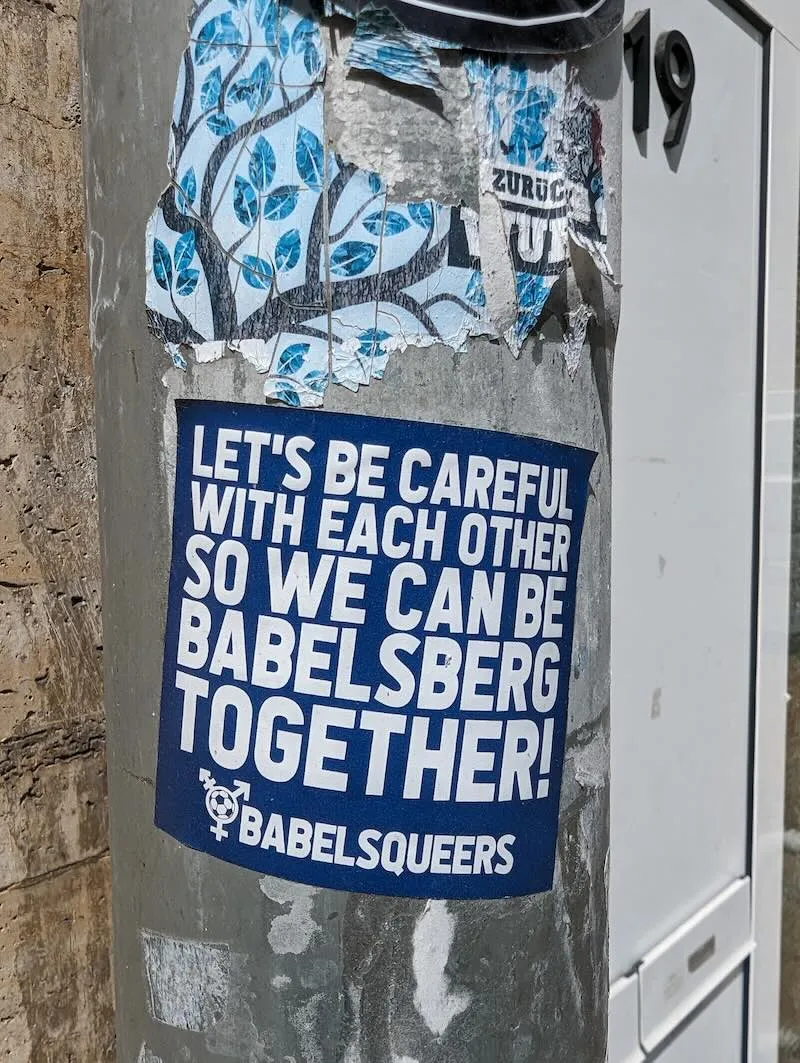
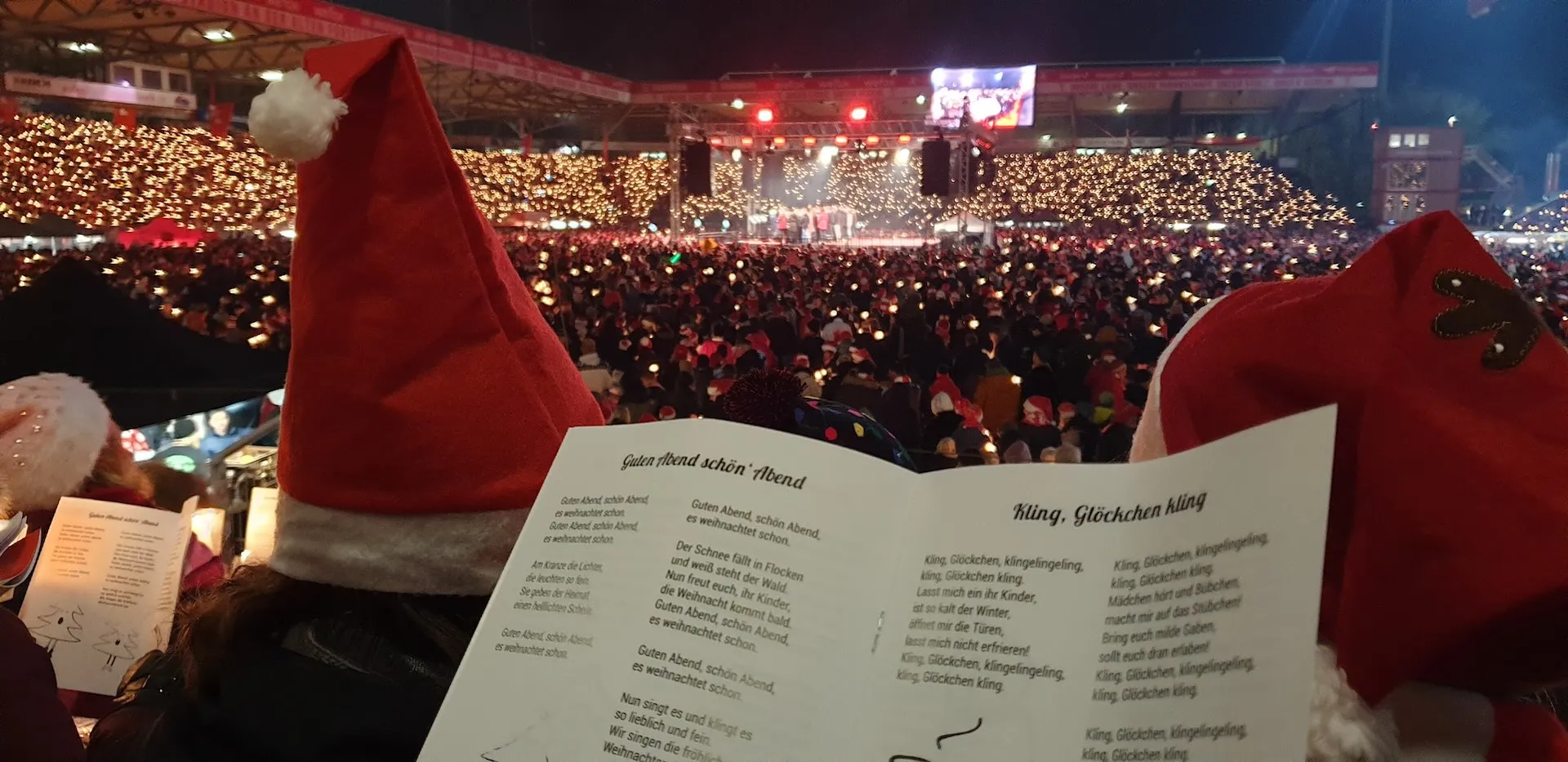
You can also get involved with Union’s two different social causes, UNION VEREINT. Schulter an Schulter or Eiserner V.I.R.U.S. e.V., both of which run various social projects. For more information, visit their websites. Another unique tradition is the Union Berlin Weihnachtssingen, where thousands of fans gather at the stadium to sing Christmas carols together. The event is always led by local school choirs, and even big celebrity singers have been politely rejected to keep the community spirit alive.
Hertha also has several social causes, including 1892HILFT and Aktion Herthakneipe, Hertha fans regularly share fan news and gameday actions here.
You can also join and sing Christmas carols in a stadium:
Where to watch football live in Berlin?
The obvious and most authentic way would be to go to a stadium. We collected some information and tips on where to go. You can mostly be very spontaneous except with Union Berlin tickets.
How to buy tickets for Hertha BSC?
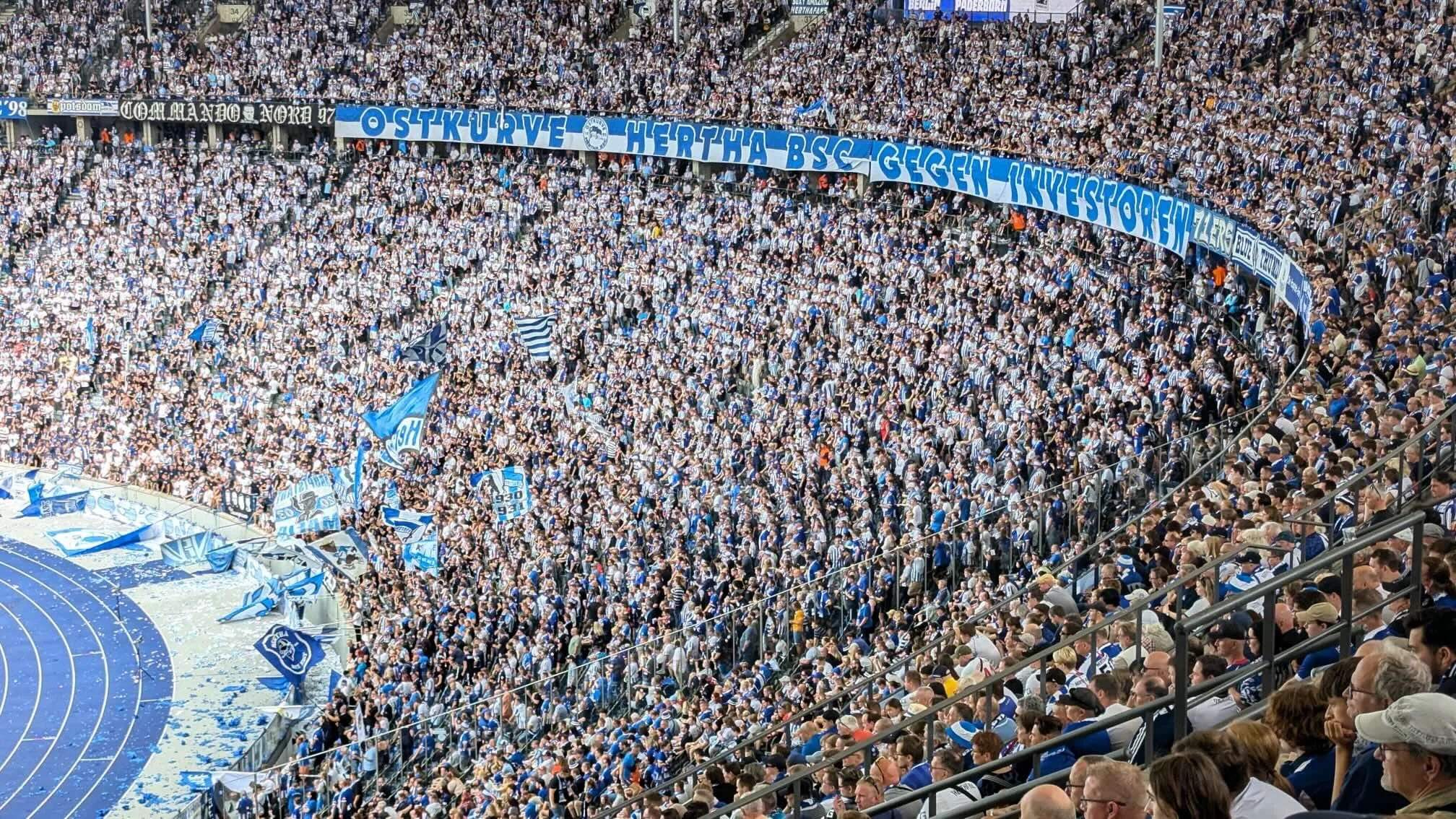
Located in Westend, the Olympiastadion is Berlin’s biggest and most famous stadium. Although the stadium is owned by the city, Hertha BSC plays its home matches here. Its size (capacity is almost 75,000) means getting tickets is usually pretty straightforward. They are generally available on their website up to and on the day of the match (none of the Hertha’s 17 home games in 2023/24 season were sold out).
Hertha BSC at Olympiastadion, Ostkurve, opening game of the 2024/2025 season against Paderborn:
How to buy tickets for FC Union Berlin?
Located in Köpenick, the Stadion An der Alten Försterei is a charming old stadium built in 1920, it’s the largest football-specific stadium in Berlin. Bundesliga side Union Berlin (and, from the 2024/2025 season, their women’s team) play their home matches here. Tickets for the men’s team can be extremely difficult to come by and usually sell out. For example, in the 2023/2024 season, Union averaged 21,841 fans in the stadium with a capacity of 22,012. Renovations have begun to increase the capacity.
Tickets are first offered to club members, who enter a lottery due to high demand. Non-members should keep an eye out for tickets during the Freier Vorverkauf phase (general sale), though it’s not always offered for Bundesliga games. Preseason matches, early DFB Pokal rounds, and women’s matches are better options for availability.
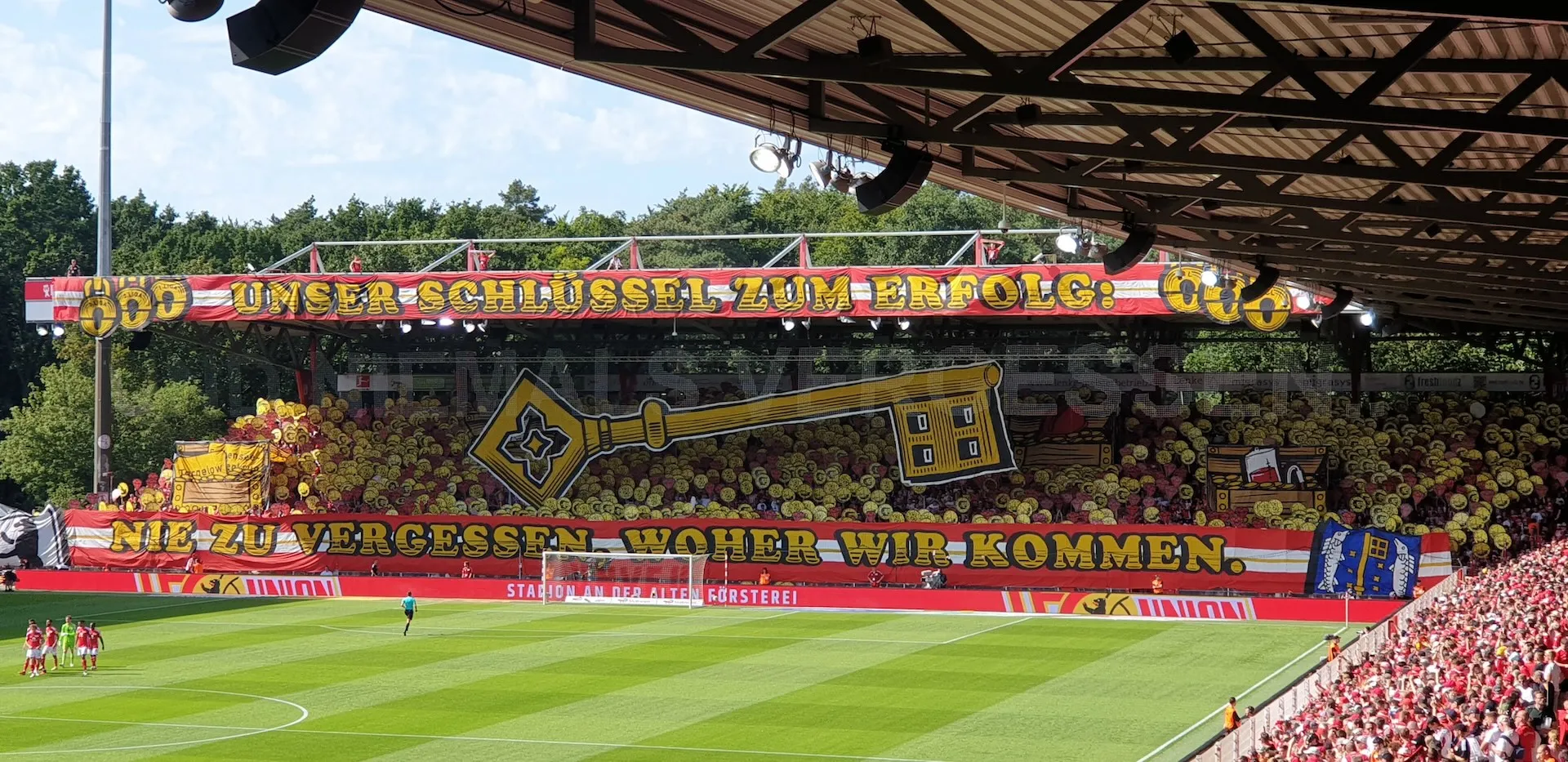
A tip: if you manage to get a ticket for stands, arrive at least 45 minutes early to find a spot (gates open 2 hours before kickoff). Sector 2 (Die Wald-Seite), behind the north goal, is where Union’s hardcore fans stand. Avoid taking close-up photos of them. Sector 3, the largest standing section, gets direct sunlight at the bottom, so it’s better to stand at the top.
Sector 2 (Die Wald-Seite) as seen from Sector 3:
Despite being one of the first women’s teams established in the former East in 1969, Union’s women’s team were only recently added to the club’s professional department ahead of the 2023/2024 season. How did that season go? They won all 22 of their games, scored 145 and conceded just five goals as they easily won promotion to the 2. Bundesliga for the first time!
Turbine Potsdam and SV Babelsberg at the Karl-Liebknecht-Stadion
Located in Potsdam-Babelsberg, Karl-Liebknecht-Stadion is home to Frauen-Bundesliga side Turbine Potsdam and SV Babelsberg 03. Turbine Potsdam, a former women’s football powerhouse, enjoys a sizable fan base and a family-friendly atmosphere at the stadium. Tickets are available online or at the stadium.
SV Babelsberg 03 vs. FC Energie Cottbus (Karl-Liebknecht-Stadion) in 2023/2024 season:
Semi-professional and amateur football around the city
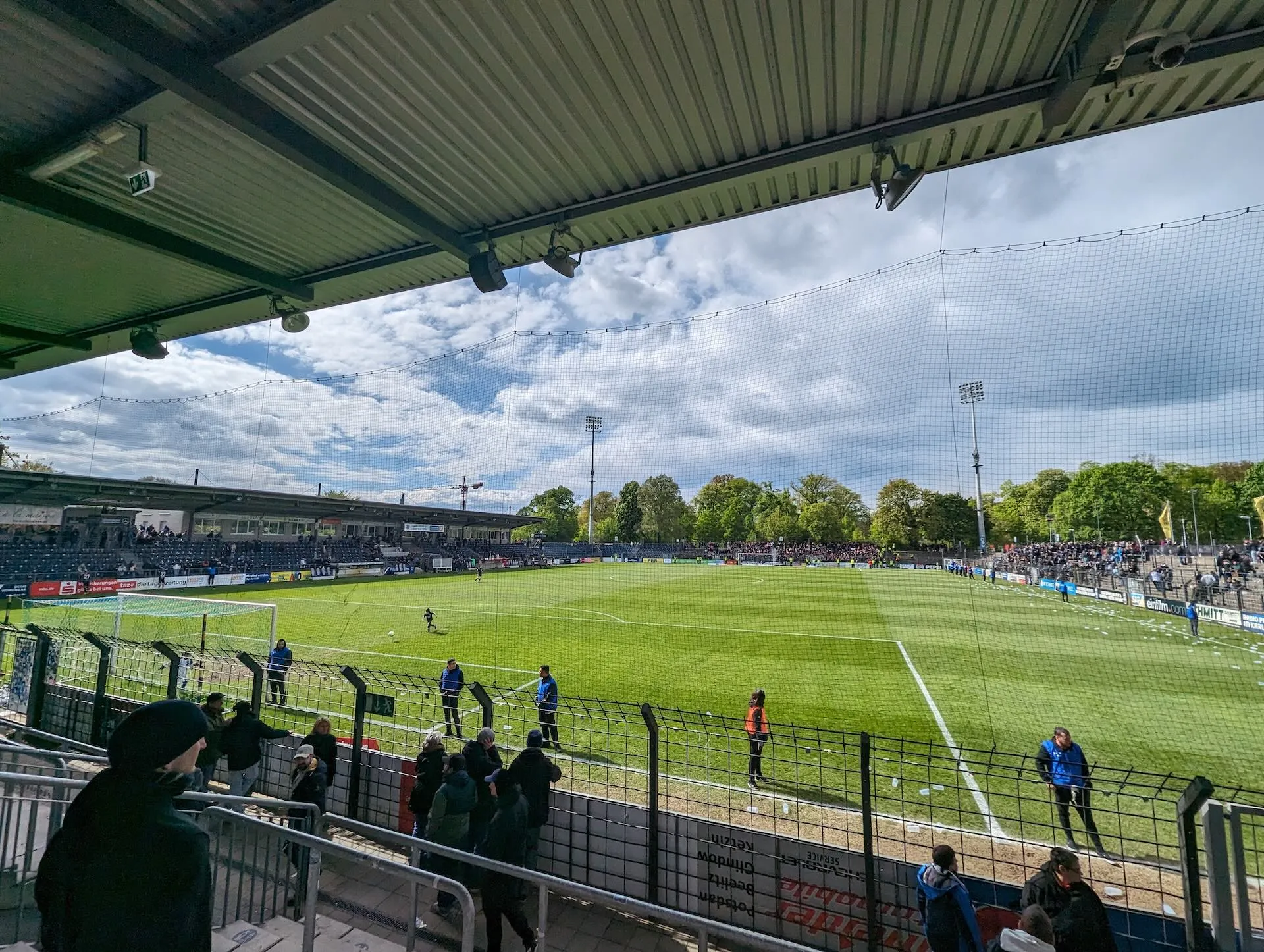
Berlin’s football scene is vibrant, with hundreds of teams across 11 divisions, ranging from the near-professional 4th tier down to the Kreisliga C. The city offers a range of football experiences, whether you’re a dedicated supporter or a casual observer.
Diverse Attendances and Atmospheres. Attendance at matches in the 4th and 5th divisions can vary widely, with some games attracting just a few hundred fans while others draw several thousand, depending on the opponent, time of year, and team performance. Still, tickets can almost always be purchased at the stadium just before the match. Clubs like BFC Dynamo and Tennis Borussia Berlin, with their storied histories and larger fan bases, can attract larger crowds, especially for high-stakes matches or local derbies.
Community and Culture. At smaller clubs, there’s often a warm, community-oriented atmosphere. These matches serve as a social hub for locals, where family and friends gather to enjoy the game together. Whether you’re looking to immerse yourself in this culture or simply enjoy a relaxed day out, there’s a welcoming vibe at most of these events.
Supporting ‘Strategies’. There are different ways to engage with the local football scene. Some fans are loyal supporters who attend every home game, while others practice ‘groundhopping’ - visiting different stadiums and experiencing new teams each week.
How to find a football match near you in Berlin?
To find a game near you, tools like fussball.de or the Futbology app are invaluable. These resources list fixtures, venues, and other relevant details, making it easy to plan your football outings. Whether you’re seeking a specific club or just want to explore the local football landscape, these tools are excellent starting points.
Stadium-going tips and information for beginners
Here are a few tips and things to be aware of when going to a match:
Bags. Most (professional) stadiums allow bags up to DIN A4 size (297 mm x 210 mm with a depth of max. 15cm). The contents of your bag will likely be checked when entering the stadium. Full lists like this one from Hertha BSC are usually available on the club’s ticket site. The lower the level, the more lax the rules are on this—you can bring your backpack to a Kreisliga match.
Sections:
- Supporter section(s): Generally the cheapest tickets and usually a standing section located behind the goal. The most atmospheric option - you can expect constant singing, chanting, jumping and maybe even a flare or two.
- Family section: Most professional stadiums have a family section—it’s just normal seats, but smoking is usually not permitted (most stadiums still allow smoking in other sections).
- ‘General’ seats: There is probably nothing too surprising here—a seat in the stadium! The experience can vary depending on the stadium and the location inside the stadium.
- Accessibility and wheelchair seats: Berlin’s largest stadiums (including Olympiastadion, Stadion An der Alten Försterei, Friedrich-Ludwig-Jahn Sportpark and more) all offer barrier-free access and wheelchair seating sections.
- Open: Almost every club in Berlin from the 4th tier on down will allow you to sit, or stand, where you like. Variations include many sections at Union’s stadium (where ~80% of the capacity is standing). You are assigned to a ‘block’ and can stand anywhere in this block.
Food & Drink. Brats, bretzels, currywurst and beer are the norm, but some stadiums have more adventurous options like Steak im Brötchen, Kesselgulasch and Purzelchen or even Döner. Sometimes, they take card payments (at the Olympiastadion, for example), but, like everywhere else in Berlin, it’s best to bring some cash too (don’t forget Pfand as well).
Safety. Fan violence is rare and usually confined to ultra groups, but it’s good practice to stay alert, as incidents can happen. Matches between rival teams will have a ‘high risk’ designation, which includes increased police presence (at the stadium and at public transport stations) and separate entrances.
Where to watch football in bars in Berlin?
If you’d like to watch at home, you’ll need to buy one of the streaming services. But if you’d like to meet others, head out to a bar/pub/sports bar. Most of the places on the list will show Bundesliga, Champions League and important international games. Some also show other European leagues.
If possible, we linked to their websites, where you can sometimes find the schedule. Most bars don’t take reservations unless you are a regular.
In addition, Union fans keep track of all the places which show Union games.
Charlottenburg
Birgit’s Pub - Fritschestraße
Charlottchen Brasserie - Droysenstraße
Friedrichshain
Bretterbude - Niederbarnimstraße (FC Bayern Fankneipe)
Country Cheers - Karl-Marx-Allee
Sportsbar Lolly-Pub - Samariterkirche
Hops & Barley - Wühlischstraße
Hannibal Restaurant - Wühlischstraße
Kreuzberg
Weisse Taube - Wiener Str.
Vogt’s Bierexpress - Mehringdamm
Destille Kreuzberg - Mehringdamm
Biergarten Golgatha - Katzbachstraße & Monumentenstraße
Blarney Pub - Methfesselstraße
Bar11 - Wiener Str.
Wiener Blut - Wiener Str.
Oberbaumeck - Bevernstraße
Köpenick
Tusches Kick and Rush - Am Generalshof (run by Union legend, Torsten Mattuschka)
Abseitsfalle-Fankneipe - Hämmerlingstraße (Union Fankneipe)
Mitte
FC Magnet Bar - Veteranenstraße
Sportsbar Tor 133 - Torstraße
Kilkenny Irish Pub - Am Zwirngraben
Belushi’s (Mitte) - Ziegelstraße
Belushi’s (Alexanderplatz) - Rosa-Luxemburg-Straße
Denk - Mal - Lounge Pub - Auguststraße (BVB Fankneipe)
The Lir - Flensburger Str.
Neukölln
Rosel - Weserstraße (Hertha Fankneipe)
Astra Stube - Weichselstraße (FC St. Pauli Fankneipe)
Brinks am Hermannplatz - Hasenheide
Prenzlauer Berg
Tante Käthe - Bernauer Str.
Cliffs of Dooneen - Husemannstraße
Sportslounge - Milastraße
Spandau
Gänsemarkt - Spandau (Hertha Fankneipe)
Falkenseer Krug - Falkenseer Chaussee (Hertha Fankneipe)
Tempelhof-Schöneberg
Fränky - Laubacher Str. (Hertha Fankneipe)
Vereins-Eck 67 - Friedrich-Wilhelm-Straße (Hertha Fankneipe)
Don’t forget to check out co-authors Nik’s football related blog, The Backroom Staff, or join Davyd’s tip-based guided tour. I’d also like to thank Juan Almeyda for significant improvements in several sections of the article.
How is Berlin’s football organised? From the top tier to Kreisliga.
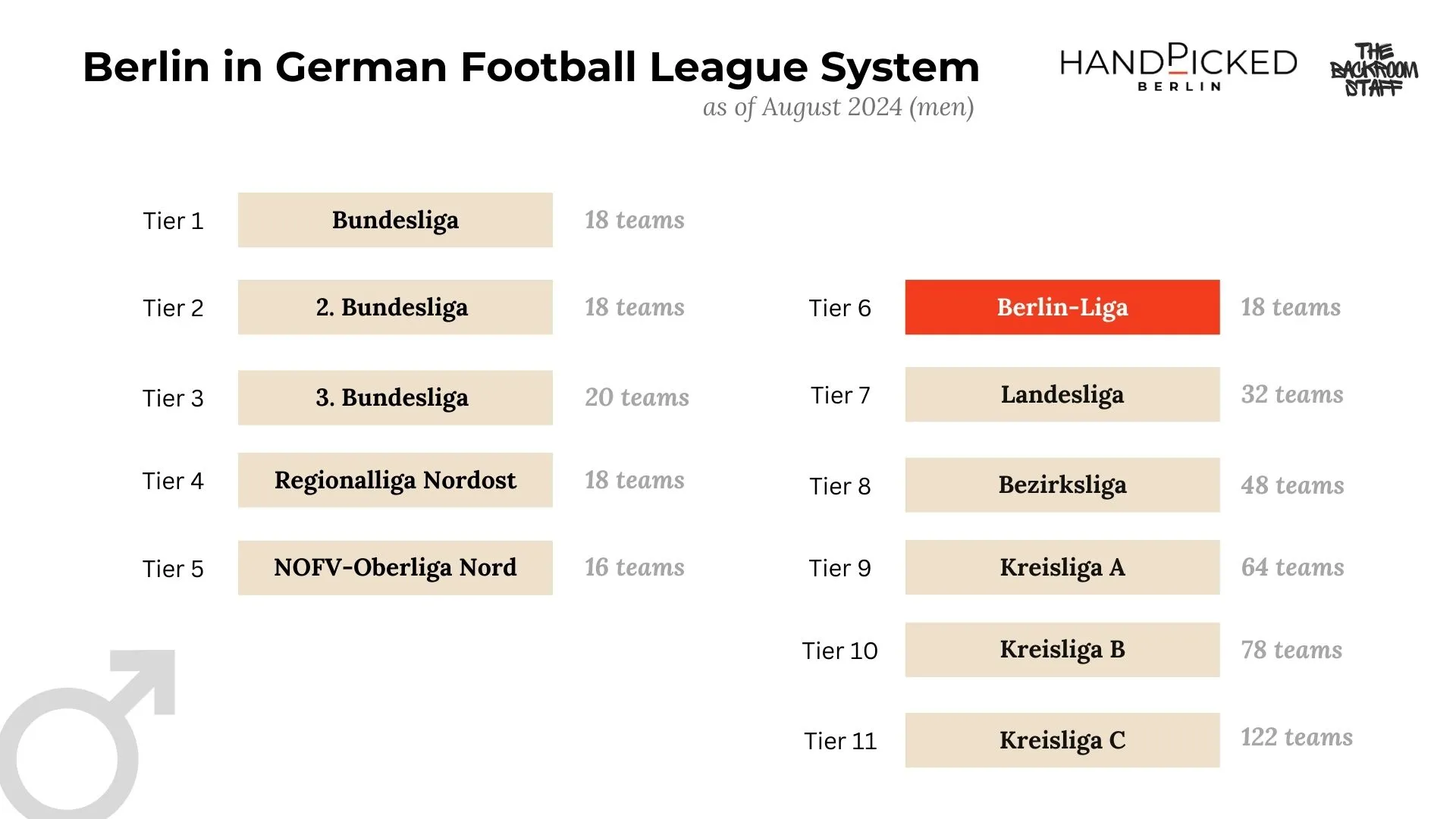
From the shining lights of the Bundesliga to the Kreisliga, football in Germany operates as a (mostly) open ecosystem, with clubs competing each season to be promoted (or at least to avoid relegation!).
As of August 2024, the lowest tier played in Berlin was 11th. As you can see, some tiers also have several ‘sub-leagues’ (Kreisliga C, for example, had 8 different ones in the 2024/2025 season). For more on the male German Football League system, there is always Wikipedia.
Here is a link to see how, for example, NOFV-Oberliga Nord looked for the 24/25 season. All the rest of the leagues, along with historical data, are also available.
We prepared a similar chart for women, where the lowest tier in August 2024 was sixth. More on Wikipedia.
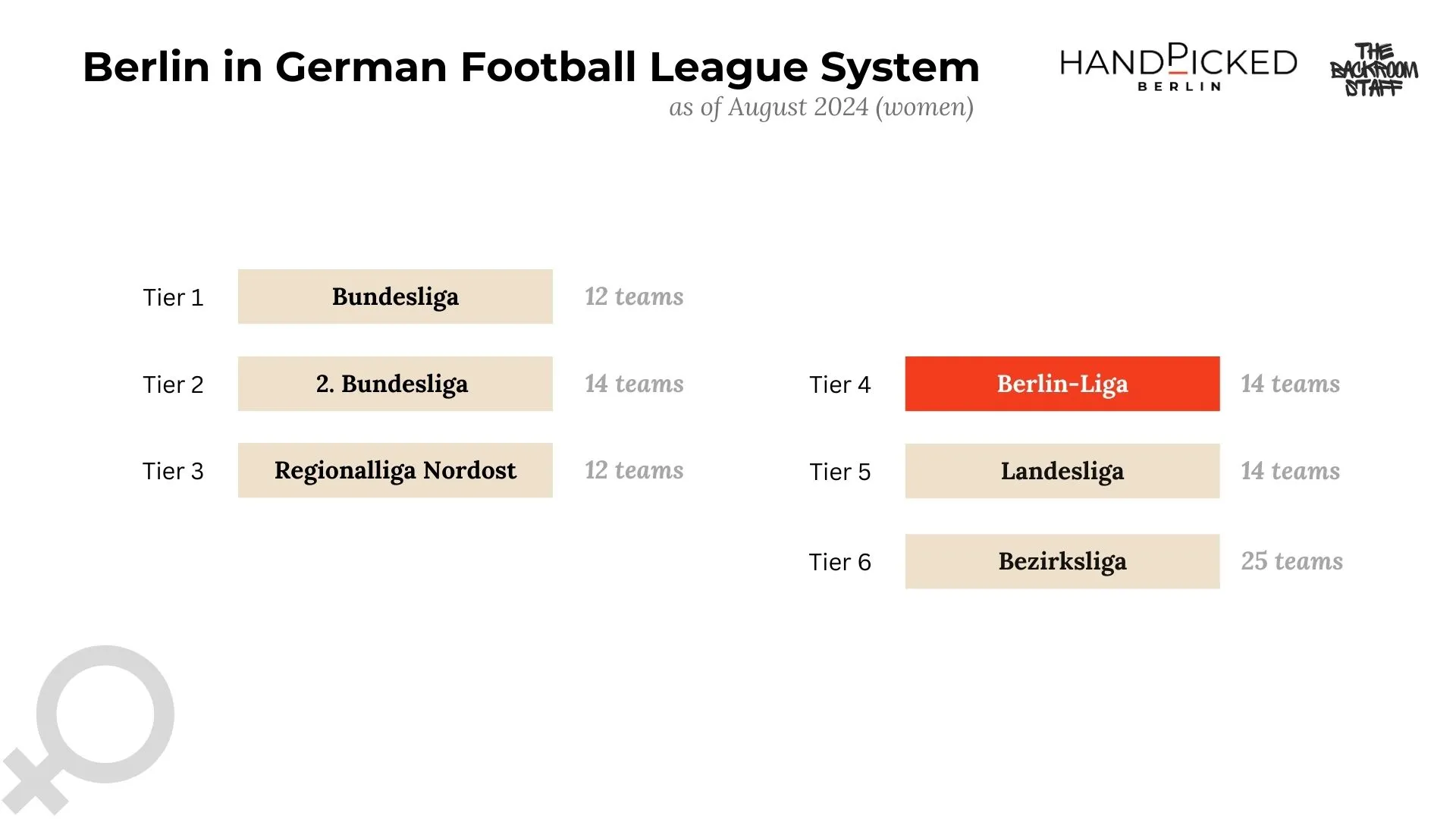
In addition to this, the Berliner Fußball Verband (BFV) organizes multiple divisions in a 7-a-side pyramid and multiple ‘oldies’ and Freizeit divisions, with over 200 teams across the men’s and women’s divisions.
What is Berliner Pokal?
The Berliner Pokal is Berlin’s premier cup competition. A single elimination tournament featuring teams from every (non-professional) division for a chance to earn a place in the national cup competition (the DFB-Pokal), where they can be drawn against Bundesliga sides (and, crucially, earn hundreds of thousands of Euros).
For example, in August 2024, the 2023/2024 winner, 4th tier Viktoria Berlin, hosted FC Augsburg from the Bundesliga at Friedrich-Ludwig-Jahn Sportpark (Mauerpark).
The early rounds can be a great way to experience lower-league football in Berlin, with cheap (or even free!) tickets, warm weather and a tendency for drama and upsets.
Which are other notable Berlin football clubs?
Although Berlin largely lacks the footballing success of other European capitals, it has a rich football history and many historic clubs across the divisions.
Tennis Borussia Berlin
The main rivals of Hertha BSC in the 20s and 30s, ‘TeBe’ reached the Bundesliga twice in the 70s but have largely struggled financially and have been a fixture of the lower leagues for most of their recent history. Still, they enjoy large support and are notable for their active fan scene. They play at Mommenstadion in Westend.
BFC Dynamo
Traditionally one of the biggest clubs in Berlin and East Germany. Record champions of the DDR - they won the DDR-Oberliga ten times in a row between 1979-88. Perhaps most notable as the favourite club of the Stasi leadership (Erich Mielke was honorary president) and for their dedicated supporters. They play at the Sportforum Hohenschönhausen in Alt-Hohenschönhausen.
Viktoria Berlin
Officially the largest football department in Germany (!), with 65 teams across all age groups. The club was ‘created’ in 2013 by a merger of BFC Viktoria 1889, one of Germany’s oldest clubs, and Lichterfelder FC, and it has been one of the most successful non-professional clubs in Berlin since. They play at Stadion Lichterfelde in Lichterfelde.
BFC Germania 1888
Germany’s oldest active football club has a crazy history and was very influential in the growth of football in Berlin. They are very much an amateur side and will play in the 10th tier, the Kreisliga B, in 2024/25. They play at Sportplatz Götzstraße in Tempelhof.
As you explore the divisions, you can see clearly how Berlin’s cultural diversity is reflected by local football clubs. Clubs like Makkabi Berlin, Croatia Berlin, Polonia Berlin, Berlin Türkspor, Club Italia Berlin, DFC Kreuzberg, and so many more reflect Berlin’s international and diverse spirit.
How can you add football to your tourist experience of Berlin?
Easy. Go and see a local match (you can find them here). But you can also explore Berlin’s rich football history and culture on a range of tours and sites.
Which football-related guided tours are available?
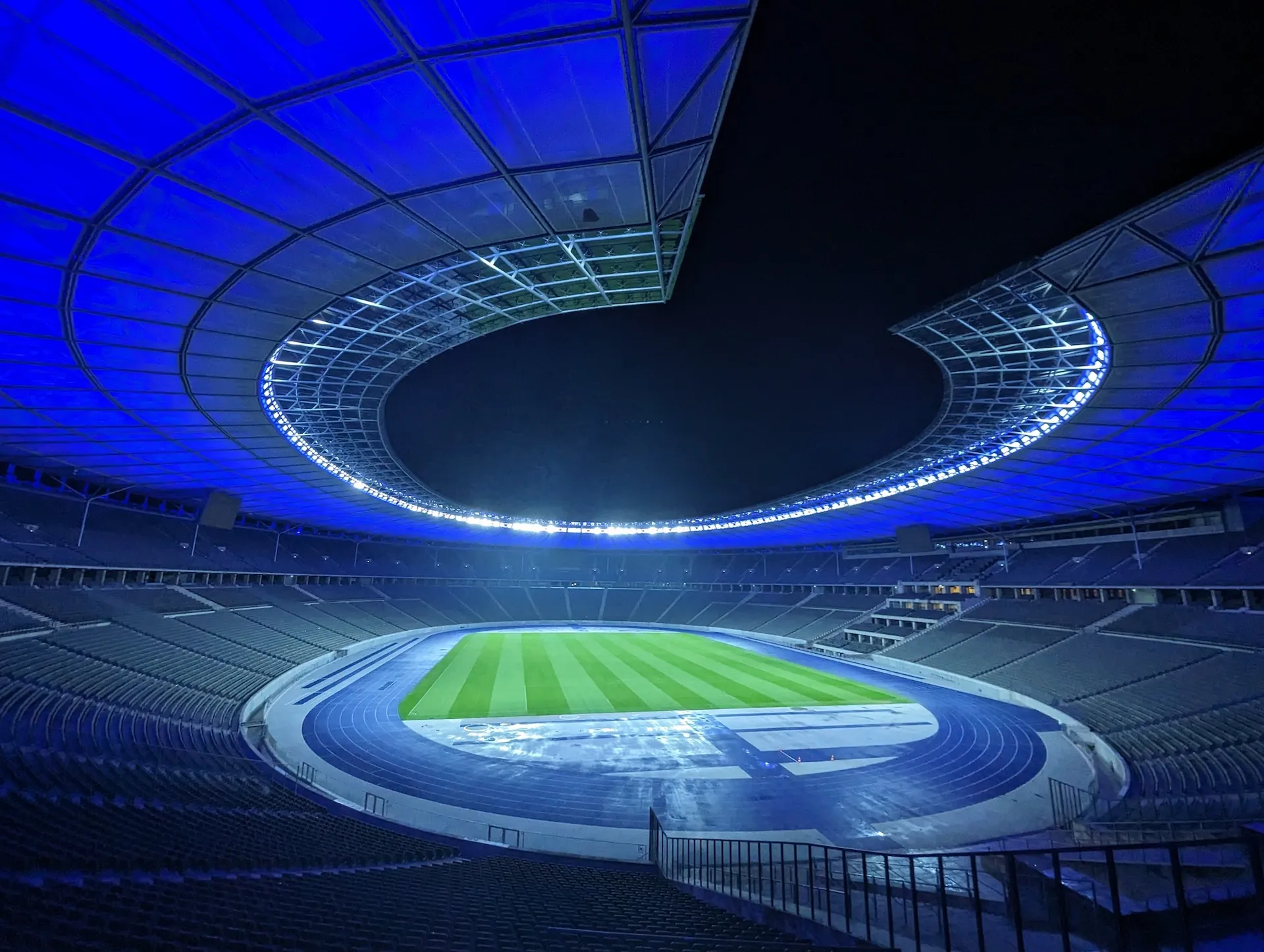
Olympiastadion. The Olympiastadion is a monumental venue with a storied past, having hosted events from the 1936 Olympics to the 2006 FIFA World Cup and the recent European Championship 2024 final. Their guided tours provide a comprehensive look at the stadium’s architecture and history. Don’t miss the Light Experience Tour, which features stunning light and music displays, adding a unique dimension to your visit.
Light Experience Tour:
Stadion An der Alten Försterei. Home to 1. FC Union Berlin this stadium offers an intimate and passionate football experience. Regular stadium tours started in 2022, primarily in German. However, the club is open to arranging English tours upon request. You can email touren@altefoersterei.berlin to express interest in English tours. Hopefully the club can make English language tours a regular offering.
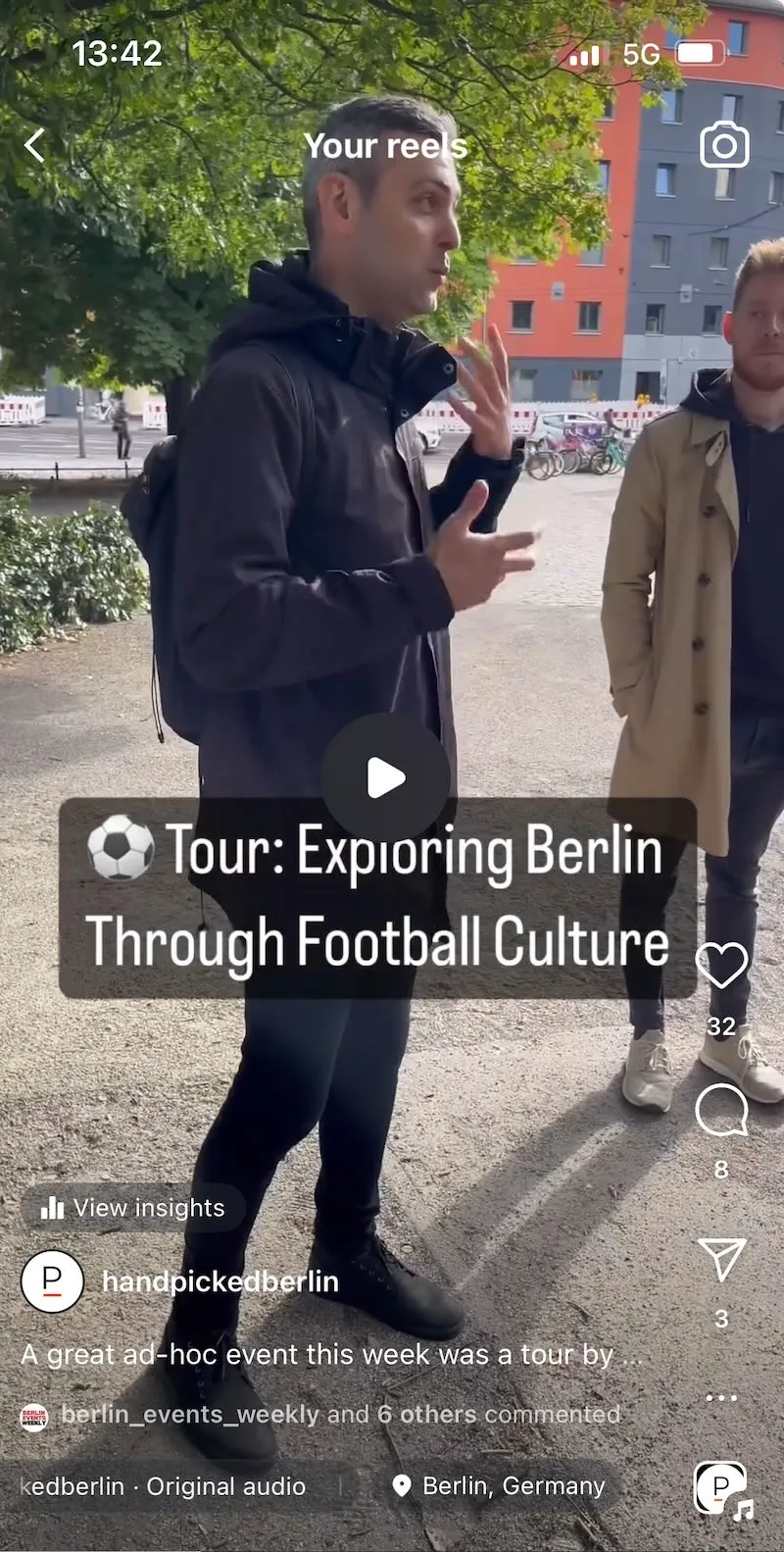
Beyond the Game: Exploring Berlin Through Football Culture. For a broader cultural experience, consider joining a weekly tour that explores Berlin through the lens of football. These tours offer a mix of historical insights, cultural context, and visits to key football-related sites, giving participants a well-rounded view of how football has shaped the city.
A short reel from the tour can be seen on Instagram (paused at Davyd’s intro):
Self-guided tours
Explore Berlin’s football heritage at your own pace with self-guided tours. Ideal for those who prefer a flexible schedule, these tours can be done on foot or by bike.
Football Route Berlin. Follow the Football Route Berlin to discover significant football landmarks throughout the city. This route includes historical sites, murals, and venues connected to Berlin’s football narrative.
Alltag in der DDR - Museum in der Kulturbrauerei. This free museum offers insights into everyday life in East Germany, with a dedicated section on football. It’s a good look at how the sport intersected with politics and culture during the GDR era.
Sportmuseum Berlin. Situated within the Olympic Park, the Sportmuseum Berlin boasts an impressive collection of items related to football, including vintage uniforms, trophies, and photographs. It also covers other sports such as athletics, gymnastics,swimming and provides a comprehensive look at the city’s sporting legacy.
Where to see football outside Berlin?
Day trips
Looking for a football adventure outside Berlin? Here are some affordable day trips to catch games in various leagues, with some fascinating cities to explore! Of course, you can drive, but trains are also a great option.
Deutschlandticket Away Days
Travel for free on the Regiobahn:
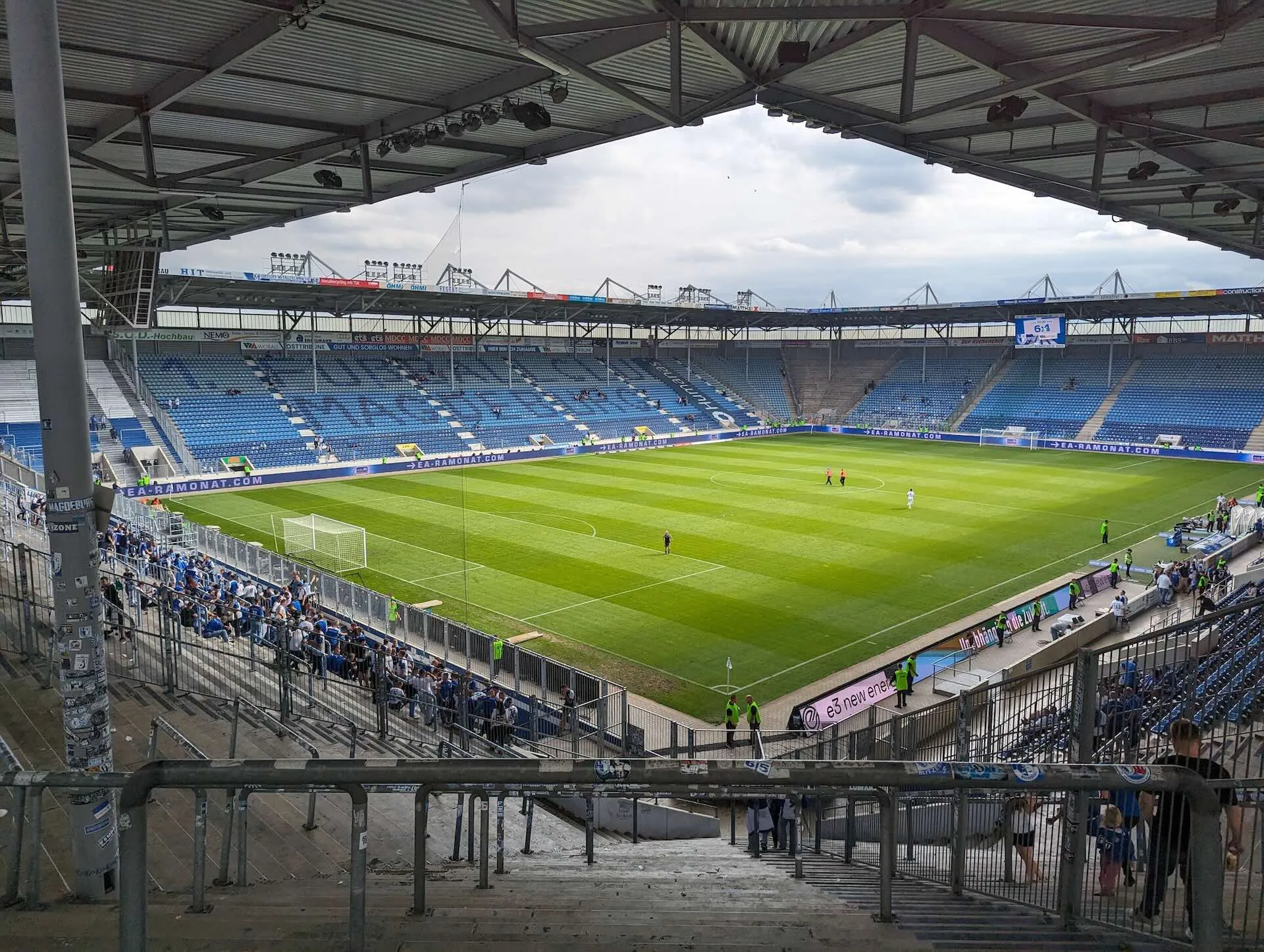
FC Magdeburg (current league position) in Magdeburg, app. 1.75h train trip: 1. FC Magdeburg, an old DDR-Oberliga powerhouse and the only East German club to win a European trophy. Known for passionate fans. Magdeburg is also a lovely city to explore! Tickets.
FC Hansa Rostock (current league position) in Rostock, app. 2.5h train trip: Hansa Rostock, famous (or infamous?) for their spirited supporters. Tickets.
Energie Cottbus (current league position) in Cottbus, app. 1.5h train trip: Energie Cottbus, notable for being the first Bundesliga team with an all-foreign starting eleven, are back in professional football. Fun fact: Angela Merkel is an honorary member. Tickets.
Supersparpreis ICE/IC
Affordable trips under 2 hours and €50 (check FlixTrain too):
RB Leipzig (current league position) in Leipzig, app. 2h train trip: RB Leipzig, (controversially) backed by Red Bull, is a top German club and regular Champions League contender. RB’s women’s side also competes in the Frauen-Bundesliga. Tickets. The city also features vibrant lower league teams, Lokomotive and Chemie Leipzig.
VfL Wolfsburg (current league position) in Wolfsburg, app. 1h train trip: VfL Wolfsburg, backed by Volkswagen, is a Bundesliga mainstay. Their women’s team is the most successful in Germany and their 2024/2025 team featured 15 (!) German national team players, including stars like Alexandra Popp & Jule Brand. Tickets.
Eintracht Braunschweig (current league position) in Braunschweig, app. 1.5h train trip: Eintracht Braunschweig has a rich history as a founding member of the DFB and Bundesliga champions in ‘67. They are also notable for being the first German club with a sponsor’s logo (Jägermeister) on their jersey. Tickets.
Dynamo Dresden (current league position) in Dresden, app. 2h train trip: Dynamo Dresden is one of the DDR’s most successful teams (in part due to their ‘privileged’ relationship with the Stasi). Dynamo is one of the best-supported clubs in the third tier and is notable for its elaborate tifos in the fan block. Tickets.
Bonus in neighbouring Poland: Pogoń Szczecin (current league position) in Szczecin, app. 2h bus trip: For an adventurous day trip, head to Szczecin to watch Pogoń Szczecin, one of Poland’s better teams. Tickets.
Important news, blogs, channels, documentaries and other Berlin football-related resources
Berlin’s football scene is vibrant and diverse, supported by a range of official organizations and enthusiastic communities. Here’s how you can connect with them:
Berliner Fußball Verband (BFV). The BFV is the official governing body for football in Berlin, overseeing leagues, clubs, and competitions. Their website offers a wealth of resources, including league information, training materials, and events. Whether you’re a player, coach, or fan, the BFV provides essential information for staying engaged with the local football scene.
FuPa Berlin. FuPa is a valuable online resource for players and coaches looking for clubs, as well as for clubs seeking test matches. Additionally, through FuPa, you can also search for opportunities in other regions and states.
Calcio Berlin. While primarily focused on German football, this podcast covers a range of topics relevant to Berlin football fans, providing in-depth analysis and commentary.
Union Berlin - English Language Fan Blog & Podcast. This blog and podcast offer English-speaking fans insights into Union Berlin, covering matches, player news, and fan culture. You can also find lyrics to Union’s chants here.
KickTV Amateurfußball. This YouTube channel showcases amateur football highlights from various leagues and competitions, including those in Berlin. It’s a great resource for discovering local talent and staying updated on amateur football events.
Underground of Berlin - DAZN Documentary. This German-language documentary on DAZN explores the golden generation of Hertha BSC from the early 2000s, providing a nostalgic look at the club’s history and development.
Vereinsfußball ist Struktur, Straßenfußball ist Anarchie. This German-language documentary examines Berlin football’s grassroots level in detail. It highlights the contrast between structured club football and the anarchic nature of street football, showcasing the passion and community spirit that drive the local football culture.
Union - Die Besten aller Tage (trailer). A documentary about Union Berlin, released in 2024.
“Eisern Union!” by Tim Evers. An excellent 2022 documentary produced by RBB that was unfortunately only available online until 25.10.2023. Related.
Kit Holden. An author and journalist specializing in Berlin football, particularly Union Berlin. His works offer deep insights into the city’s football culture. In his 2022 book Rise of Union Berlin - Scheisse! We’re Going Up!: The Unexpected Rise of Berlin’s Rebel Football Club he chronicles the extraordinary ascent of Union Berlin, offering a detailed narrative of the club’s journey and its significance in Berlin’s football landscape. Additionally, Holden’s pre-Euro 2024 book covers German football in a broader sense, providing context and analysis leading up to the Euro 2024 tournament.
rbb Fußball online and on Instagram. Covering the Berlin and Brandenburg area, rbb Fußball provides extensive coverage and analysis of local football.
Don’t forget to check out co-authors Nik’s football related blog, The Backroom Staff, or join Davyd’s tip-based guided tour. I’d also like to thank Juan Almeyda for significant improvements in several sections of the article.