How to find a great company to work for?
You knock on the door and hope someone normal opens. The other side? Likewise. Welcome to job interviewing.
The idea behind Handpicked Berlin was to publish great jobs by great companies to make knocking on the door easier. But since nothing good was ever easy, I quickly realised it’s almost impossible to identify good companies based on their job descriptions. You need much more because
companies will lie in the job descriptions the same way as candidates will bullshit on their CVs.
Nobody knows what is true. But that’s fine because applying or hiring without strong references is risky for both parties, so the playing field is almost level. Companies, however, have a clear advantage because of the probation period, specialised recruiting teams and because several people will knock on that door for that single space.
Nobody wants toxic—everybody wants great on the other side. Can we, (potential) employees, do anything to improve our chances? Yes! See, every company will be somewhere on the toxic-to-great spectrum:

Because most companies consist of teams, teams will also be somewhere on the spectrum. Based on this, it follows:
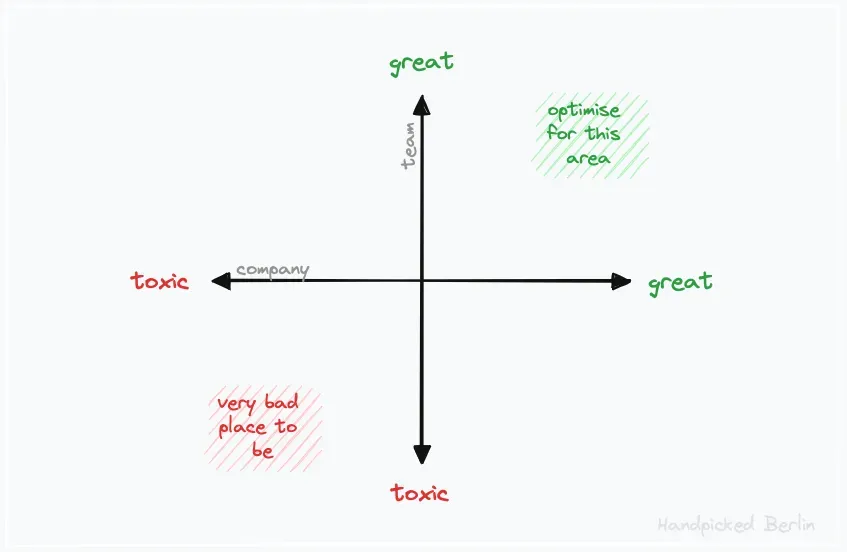
You don’t need me to tell you that “the best place to work” is in the great-great quadrant! I polled readers (Issue #77) about this matter, and 19% suffered in the “shit-shit” quadrant. Since this isn’t a PhD, I’m neglecting nuance—dozens of factors will impact the feeling of toxicity or greatness.
Because we need to work to live and consequently live to work, I wish we’d all be in a great team and company or never need to deal with anything toxic. But life’s not a fairytale, so we must optimise for greatness:
Compared with great teams, great companies are easier to find. Simply put, companies want to make money or get projects funded, and the great ones will succeed. This information is often hidden, especially with private ones. (But careful! Toxic companies can also be highly profitable!) Finally,
how can you find great companies with great teams?
Interviewing or not, being curious and following trends will help. So:
- Be interested in news and trends. Is the industry any good? Promising? Stable? Even if trends and news aren’t your thing, you can ask yourself: Who is buying their products? Will they continue to do so? How do they make money? How many competitors do they have? Are they selling shovels and picks in the gold rush?
After you get to the interview, get a good impression of who will be opening the door and:
- Google the sh*t out of the company. This will bring you to Glassdoor and other “rating” pages. Take these with a grain of salt; the same applies to “Great Workplace” awards. Instead, look for articles, forums, reviews and interviews. After reading and researching, trust your gut feeling. If you feel things are off, they are likely off.
- Ask around. Ask former and current employees how it is to work there. While on Linkedin, check the median tenure — you can also randomly click on some employees and see how long they have already been in the company. The longer, the better with a BIG but*. Bonus points for finding and talking to your potential team members.
*the environment can also be a golden cage, a stale “but we always did it that way” place. Ask about this in the interview.
This valuable research will be worth gold at your interview. When questions pop up during the research, note them down. Add them to this list you can use. On top of this research, you can also
determine your confidence level.
Thinking about probabilities or bets will help because you probably aren’t a fortune teller. At least not a successful one. Based on the research above, you simply ask yourself:
“How confident am I that the Company will do better in 3 years than today?”
You proceed by assigning a probability between 0% - 100%. At 100% you should bet your house on the company. Thinking in bets will also help you compare different companies.
How would this look in practice?
Let’s take an example from the instant grocery delivery business — Gorillas. We know where they are today (sold to Getir), but what about two years ago?
Extremes everywhere! In growth, fundraising, marketing spend and competition—big retail boys and girls PLUS other instant grocery delivery companies. All this in an extremely hard and low-margin business. I wrote “extremes”; venture capitalists and founders called it disruption.
What would be your confidence that they will be better off in 3 years?
I’d probably go with 20% because, at the time, I would think, “Well, maybe there is something in it because VCs are investing so much everywhere,” giving VCs much more credit in their abilities to pick winners than I do today.
What’s to remember? Final three takeaways:
- optimize for great/great and do everything to escape toxic,
- be interested, do research and trust your gut feeling,
- think in probabilities/bets.
If you need help or advice about the scene in Berlin, do approach me and subscribe for FREE for a weekly dose of great:
Frequently asked questions
How can I tell if a company is good to work for?
Google the sh*t out of the company… look for articles, forums, reviews and interviews. After reading and researching, trust your gut feeling. If you feel things are off, they are likely off.
Ask around. Ask former and current employees how it is to work there.
While on Linkedin, check the median tenure — you can also randomly click on some employees and see how long they have already been in the company.
What research should I do before applying to a company?
Be interested in news and trends. Is the industry any good? Promising? Stable?
Ask yourself: “Who is buying their products? Will they continue to do so? How do they make money? How many competitors do they have? Are they selling shovels and picks in the gold rush?
Are company rating sites like Glassdoor or Kununu reliable?
Take these with a grain of salt; the same applies to ‘Great Workplace’ awards. Instead, look for articles, forums, reviews and interviews.
How to spot toxic companies before joining?
Companies will lie in the job descriptions the same way as candidates will bullshit on their CVs.
Trust your gut feeling. If you feel things are off, they are likely off.
Also remember that toxic companies can also be highly profitable!
What should I look for when researching a company?
Here are four different questions to ask:
“Is the industry any good? Promising? Stable?"
"Who is buying their products? Will they continue to do so?"
"How do they make money?"
"How many competitors do they have?”
How to evaluate company culture before accepting a job?
Ask around. Ask former and current employees how it is to work there. If possible, talk to your potential team members before accepting the position.
How can I know if the company is stable before joining?
It’s not easy, but one heuristic you can use is to ask yourself: “How confident am I that the company will do better in 3 years than today?”
When interviewing, don’t shy away from asking about how they make money or how many competitors they have. Ask any other questions that come to your mind during the preparation.
This article was first published as a newsletter on January 25th 2024.