How is to work at Delivery Hero: Tech graduates
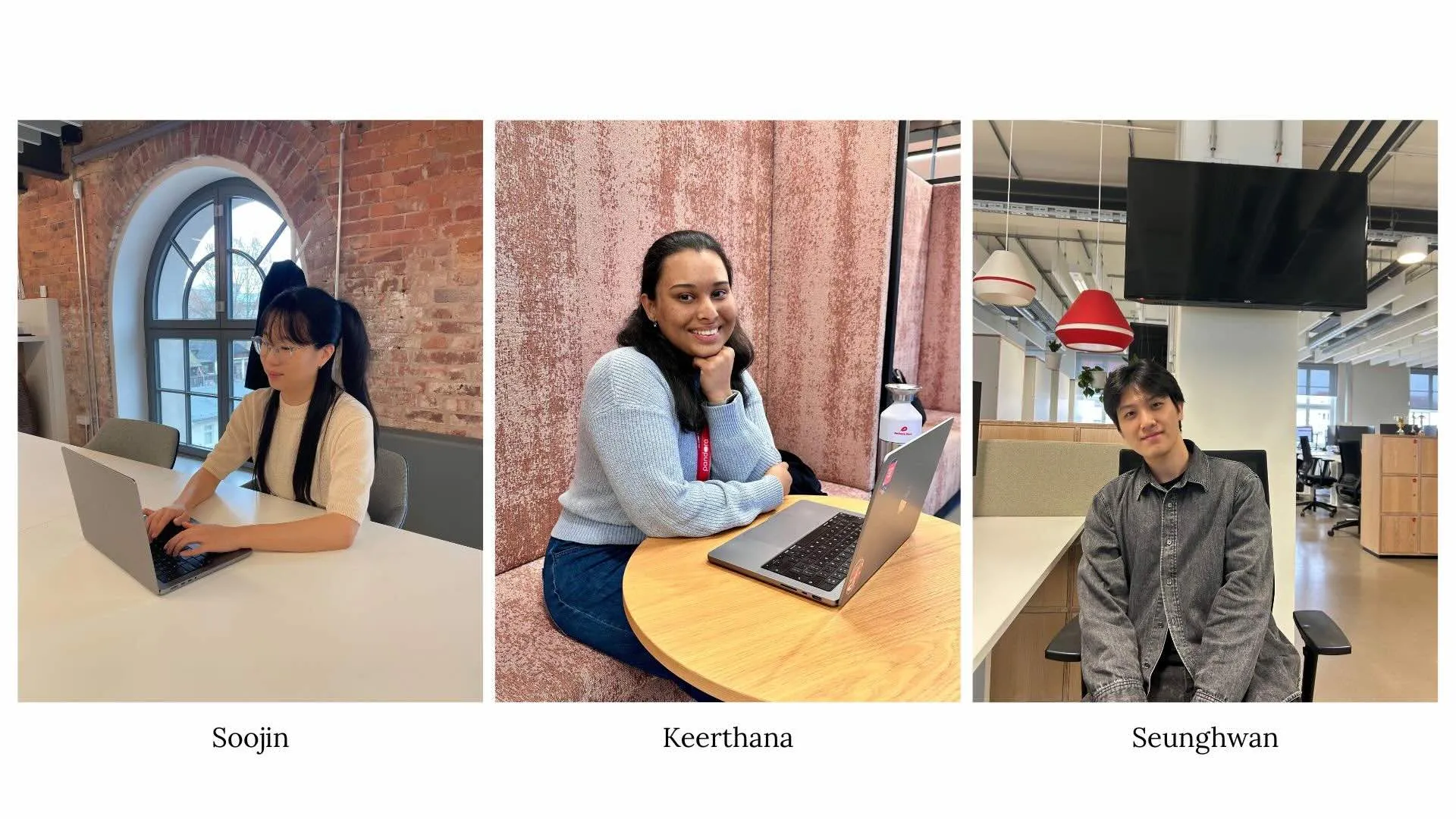
For this article, I interviewed three current participants in Delivery Hero’s Tech Graduate Program—Soojin, Keerthana, and Jason (Seunghwan). They shared authentic insights about their journey from application to daily work.
My goal was simple: let you hear directly from those who’ve lived the experience. Through seven identical questions, we explored the application process, technical challenges, mentorship experience, and company culture.
Delivery Hero’s Tech Graduate Program offers full-time, permanent positions starting June 1st and requires only six months of experience, making it accessible to recent graduates and coding bootcamp alumni. If interested, you can check out all full-time open roles here.
You can connect with Soojin, Keerthana or Seunghwan and ask them additional questions.
This article was produced in collaboration with Delivery Hero.
What specific technical skills did you develop during the Tech Graduate program so far?
Soojin: Before joining Delivery Hero, I had never worked with front-end testing tools. This program gave me hands-on experience with Cypress and Jest. Writing and debugging test cases has been a game changer in improving software quality, and I’m continuously refining my skills in test automation.
Keerthana: Prior to my journey at DH I was an embedded software engineer and was working on software for resource-constrained hardware which was in a completely different realm to the food delivery app industry. My Capstone project was a mini Backend Engineering bootcamp for me where I learnt :
- CI/CD pipelines
- Programming in Golang,
- Clean Code, Abstraction and Design Patterns in application development
- Working with AWS services like DynamoDB, Redis and Systems Manager
- Observability and monitoring performance of services through Datadog and Grafana
Jason (Seunghwan): During the program, I gained extensive experience with React Query and TypeScript, which transformed how I handle data fetching and state management. I also mastered Jest and Cypress for frontend testing, which I had minimal exposure to before. Writing robust test cases has significantly improved my code quality.
Can you walk us through your application and interview experience for the Tech Graduate program? What stood out to you, and what advice would you give to new applicants?
Soojin: I actually got rejected by a different team before joining my current one. It was tough, but a month later, completely out of the blue, the recruiter reached out again and gave me another interview opportunity. And now, I’m part of one of the best teams at DH!
The lesson? Rejection isn’t the end. Sometimes, it’s just redirection. Stay positive, be kind to the hiring team, and don’t let a “Rejection email” make you cynical. Keep applying, keep learning, and the right opportunity will come!
Keerthana: The process was exactly as outlined online, with four interviews. What struck me most was the live coding’s focus on collaborative problem-solving, rather than a race to the finish. It was a good discussion where the interviewer also provoked me to think about possible edge cases, testing strategy and alternate solutions. The final round, with my current domain lead, also included behavioural questions about dealing with tricky real-world scenarios. My advice to applicants is that being authentic and showcasing your unique approach is far more impactful than any pre-prepared answers.
Jason (Seunghwan): My interview process included a technical screening followed by a team interview with coding exercises. What stood out was how they assessed not just technical skills but also problem-solving approaches. My advice: prepare by doing coding challenges focused on explaining your thought process clearly, and research the company’s tech stack thoroughly before interviews.
Tell us about a particularly challenging project you worked on. How did you approach it, and what support did you receive?
Soojin: Unlike fixing bugs or making small modifications to an existing codebase, the Capstone Project was a completely different challenge. I had to build everything from scratch in a blank codebase. I constantly questioned myself: Am I following the team’s coding conventions? How do I justify my coding decisions to others? These concerns made the project even more challenging.
However, requesting code reviews from my mentor and doing pair programming sessions really helped. Their guidance not only improved my code quality but also boosted my confidence in navigating a new codebase independently.
Keerthana: My first project was a challenging one. We were extending the service which sends transactional messages to customers to have the ability to send scheduled notifications. A new feature meant the setup of new infrastructure, logic and extensive tests. I had a very supportive mentor who helped me break down the project into small achievable milestones, a senior software engineer who guided me through the technical doubts and reviews and my manager with whom I had regular progress and well-being check-ins.
Jason (Seunghwan): Implementing the URL filtering system for our admin panel was challenging because it required understanding the existing router setup while maintaining backward compatibility. I approached it by first mapping out dependencies, then creating a detailed implementation plan. My mentor provided code reviews and architecture guidance while giving me autonomy to make design decisions.
What different technologies or teams were you exposed to during the program, and which experience surprised you the most?
Soojin: The experience that surprised me the most was realizing that no matter how confident I am in my code, there are always areas for improvement when I get feedback from my team members. It’s fascinating how things that I can’t see in my own code are so clear to my mentors and managers. This experience has humbled me and made me eager to one day pass on that knowledge and help others on the team in the same way I’ve been supported.
Keerthana: Throughout the program, we had several events, workshops and opportunities to network with graduates from other cohorts or domains. I had insights into what data engineers, ML engineers and client engineers do through conversations with different talented people. Through the Collette program in my vertical, I also had the opportunity to have a coffee chat with a Staff Data Scientist and learn more about what his day and projects were like. I think what surprised me the most was the strong learning and collaboration culture at DH where everyone is open to share their experiences and knowledge - I just had to ask the right questions.
Jason (Seunghwan): During the program, I worked with our UI library team to integrate custom components into our Admin Panel, and collaborated with the Feature Toggle team to implement conditional rendering patterns.
In what ways has the Tech Graduate program prepared you for your current role?
Soojin: The Capstone Project really solidified my understanding of ownership in engineering. From initial design discussions to deployment, I learned how to take responsibility for a feature end-to-end. The final presentation also helped me sharpen my ability to explain technical concepts clearly.
Keerthana: The program instilled habits of rapid learning, asking questions and breaking down complex tasks, which are essential in my current role. I’m working on an anti-fraud mission that requires quick onboarding to third-party services, cross-domain communication and efficient incremental deployments as there is a cost of delay attached to tackling fraud. I also observed that being part of the Tech Graduate program helped me fight my imposter syndrome and take ownership of any tasks I work on.
Jason (Seunghwan): The program’s rotation system exposed me to different parts of the engineering lifecycle, from planning to monitoring production systems. This holistic view helps me make better architectural decisions now. The emphasis on documentation and knowledge sharing also prepared me for effective collaboration in larger teams.
What’s one aspect of Delivery Hero’s engineering culture that you think candidates should know about before applying?
Soojin: My manager recently hired a new team member who had zero prior experience with the programming language we use. That really surprised me! But it made me realize that at DH, they’re not looking for someone who’s already “perfect”, they value people who are eager to learn. I think, that is one of the most important aspects of DH’s culture.
Keerthana: The open communication, knowledge sharing, and strong accountability across all levels here create a great culture. While the fast-paced nature of the industry and frequent organizational changes can be demanding, they are ultimately empowering as I feel I can make a significant impact, even as a junior engineer. The career framework clearly outlines the expectations and managers are transparent and provide constructive feedback to help growth. As advice, there are plenty of resources, but don’t wait to be told what to do. Being proactive really makes a difference here.
Jason (Seunghwan): Delivery Hero has a strong culture of experimentation and learning from failure. Engineers are encouraged to propose solutions and test hypotheses, even if they might not work out. This creates a safe environment for growth but requires comfort with uncertainty and iteration, which might surprise candidates expecting more rigid processes.
What surprised you most about the reality of working at Delivery Hero compared to what you expected when applying?
Soojin: The career framework here is incredibly well-structured. Within days of joining, my skip-level manager walked me through exactly what it takes to get promoted. It’s refreshing to see a company that’s transparent about career growth. If you put in the work, the opportunities are there.
Keerthana: The work-life balance and the benefits are as good as advertised! The company cares for the employee’s well-being and there are a lot of employee resource groups internally that create a sense of community. The diversity here is definitely a strength and everyone I have met here is extremely skilled and empathetic, which helps foster the growth of a new joiner.
Jason (Seunghwan): I was surprised by how flat the organization is in practice. Even as a junior engineer, I’ve had opportunities to present ideas directly to senior leadership and influence product decisions. The level of ownership given to engineers at all levels creates a real impact but also requires taking initiative rather than waiting for assignments.
Interested in what you’ve read? Check out the current Tech Graduate Program openings on Delivery Hero’s careers page and submit your application to join the upcoming cohort.